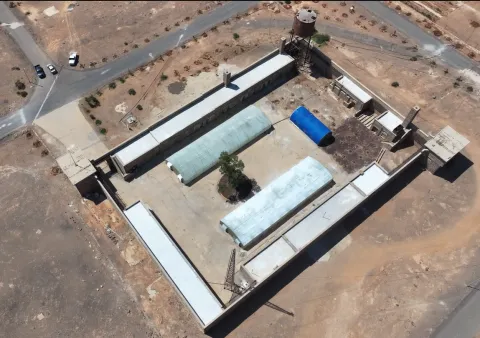
The project is divided into three main sections:
Section One: Al-Safawi Training Center for Soilless Agriculture and Innovation
Al-Safawi Training Center for Soilless Agriculture and Innovation was established to serve as a comprehensive and exemplary model for smart and sustainable agriculture, in response to the directives of His Majesty King Abdullah II bin Al-Hussein, who places great emphasis on food security and sustainable development.
The establishment of the center is based on the continuous support and visionary guidance of His Royal Highness Prince El Hassan bin Talal, aimed at revitalizing and developing the Jordanian Badia region. The center reflects the state’s strategic plans and aligns fully with the objectives of the Sustainable Agriculture Plan for resource conservation, the Green Growth Plan for integrating environmental considerations, and the Economic Modernization Vision for building a productive and sustainable economy. Accordingly, the center represents a cornerstone in achieving these national goals.
Al-Safawi Training Center for Soilless Agriculture and Innovation features advanced and integrated infrastructure designed to achieve the highest standards of sustainability and operational efficiency. All systems at the center operate entirely on solar energy, making it a unique practical model that embodies the concept of the energy–agriculture nexus and ensures environmentally friendly and sustainable operation.
This infrastructure includes the following key components:
Specialized Agricultural Meteorological Station: This solar-powered station serves as a vital source of accurate climate data. It monitors a comprehensive range of variables, including:
- Solar radiation
- Air and soil temperature
- Relative humidity
- Wind speed and direction
- Carbon dioxide concentration
- Rainfall and evaporation rates
This data provides researchers and farmers with essential information that enables them to calculate precise crop water requirements, predict potential plant diseases, and manage greenhouses efficiently, thereby reducing waste and increasing productivity.
Comprehensive Agricultural Units: The center includes two refrigerated agricultural units, each covering an area of 270 m². These units serve as a live educational platform demonstrating the most widely used practical soilless (hydroponic) farming systems, offering a unique opportunity for hands-on training and observation.
The systems include:
- Nutrient Film Technique (NFT)
- Deep Water Culture (DWC)
- Vertical Farming and Green Walls
- Dutch Bucket System
- Trench Cultivation Systems
Smart Control Unit Using the Internet of Things (IoT): This unit represents the “brain” of the entire center. It is a fully automated system that manages operations through a network of internet-connected sensors and devices. The unit performs several vital functions, including:
- Automated Irrigation: Automatically regulating irrigation quantities and schedules based on soil moisture data and information received from the weather station.
- Automated Fertilization: Injecting precise amounts of fertilizer into the irrigation water according to the requirements of each plant and its growth stage.
- Continuous Monitoring: Monitoring plant health through vital indicators, as well as environmental conditions within the agricultural units, including temperature, humidity, light intensity, and nutrient concentration.
Section Two: Rainwater Harvesting System
This section involves the installation of a rainwater harvesting system on a 1,000 m² rooftop area to provide an environmentally friendly water source for irrigating plants grown in hydroponic systems.
The work includes applying epoxy-treated concrete to the roofs of the castle building, as well as establishing a water collection and pumping system for plant irrigation.
Section Three: Landscaping and Tree Planting
This section includes the development of gardens and green spaces covering an area of 3,000 m². The landscaping incorporates medicinal and native plants, ornamental plants, and evergreen trees to enhance the aesthetic value of the station and support local biodiversity.